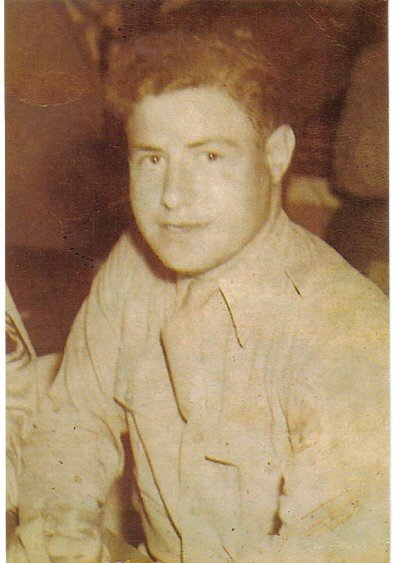
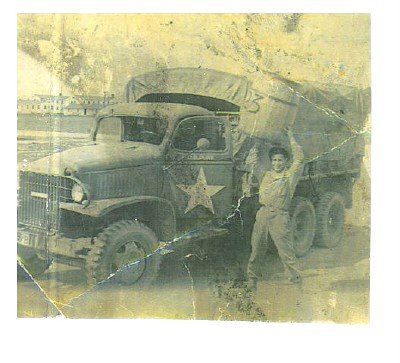
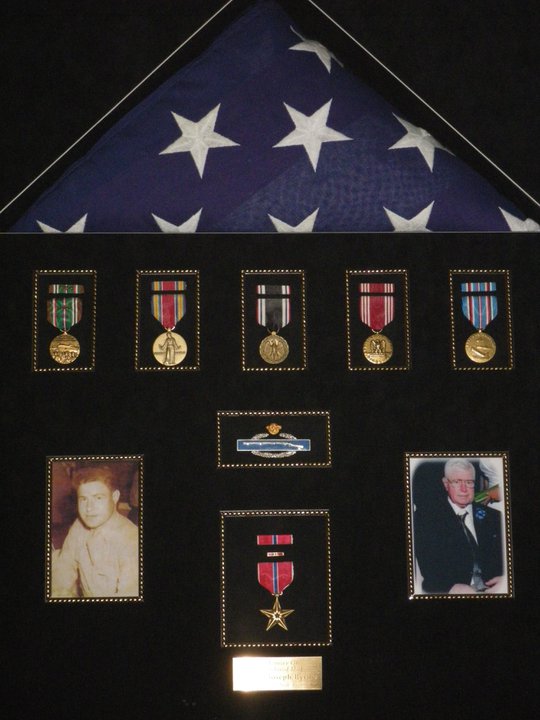
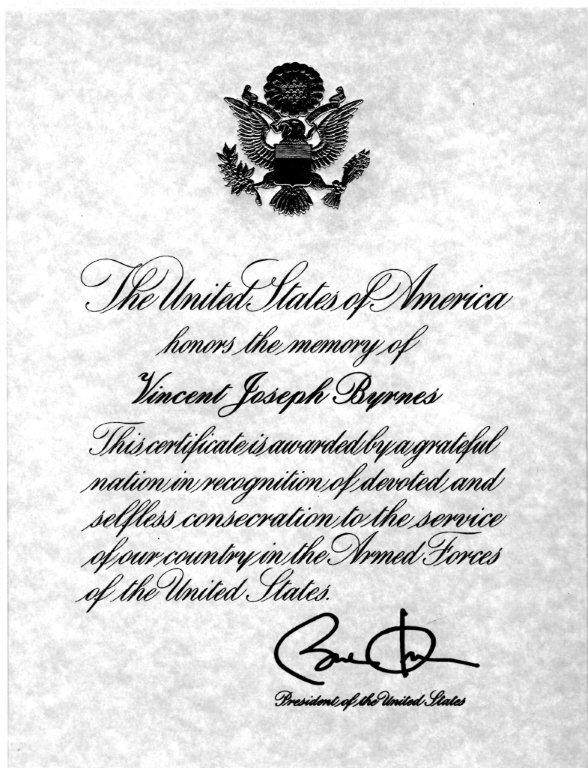
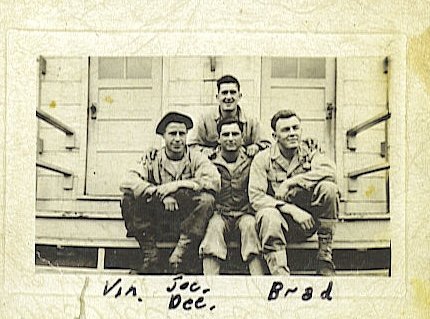
My Dad's Story
PFC Vincent Joseph Byrnes U.S. Army
106th Infantry Division 423SVC
Milton, Ma.
2/13/22-11/25/09
I have tried several times to begin my
Father's time in service and with the 106th Infantry Division
423SVC. To begin and to write is still difficult for me. As the
time since his passing is short, and I find myself becoming
emotional. As I know the story, so do I envision the man and the
suffering he and so many others endured. My research took over a
year, and yet I still came up short in a few areas.
What I do know for certain is he entered the U.S. Army Dec
29, 1942, left for Basic Training on Jan 2, 1943 to Ft Devens,
MA. From here, according to discussion my Dad held with my
husband, he was next assigned to Fort Jackson, SC. After getting
field experience in combat -alike- conditions during the
Tennessee maneuvers in January 1944, the division was
transferred to Camp Atterbury, on March 30th, 1944 for
advanced training. Although it is documented the men of the
106th shipped out aboard the Queen Mary on November 10th, 1944.
My Father's DD214 indicates he left at an earlier date. Oct 17,
1944.
Which is documented in information I received from former
106th members. The purpose of these men entering the European
theater earlier than the bulk of the 106th is not known to me. I
did learn however, once they arrived they had much down time,
and little to do while awaiting the arrival of the complete
company. I believe the location they arrived and waited was
Cheltenham, England. Where upon the arrival of the complete
division, began more intense training for their soon to be
transfer to the Ardennes.
After a brief period of consecutive training in Great
Britain, the 106th Division crossed the English Channel and
entered the European Theatre of Operations at Le Havre.
After a devastating truck ride the men entered the area of
St. Vith, Belgium on December 11th, 1944. The 106th was ordered
to relieve and take over the positions of the 2nd Infantry
Division stationed on the "Schnee Eifel" AKA "Snowy Mountains".
This was an area of rugged, pine covered hills on the border
between Belgium and Germany. The men of the "Golden Lion"
division took over the positions one by one, mostly old German
Bunkers of the West Wall that were now reinstated as "US Army
Property". There was one drawback. When the men of the 2nd
Division pulled out, they were smart enough to take all the
stoves with them. So, it would be a cold winter for the men of
the 106th.
This area was known as a relatively quiet area. But,
according to information obtained from others, the men of the
106th did not find it to be so. Many heard sound and movement
and on some occasions the voices of German soldiers. Although it
was reported, (in my opinion), it obviously was not taken as
seriously as we now know was the beginning of the end for many
who were lost, captured, and wounded. They were literally over
run beginning on Dec 16th in the Battle of their lifetime. The
men of the 422nd were literally wiped out along with many from
the 423. The 424th was further back. They retreated to fight
another day.
I can only tell you from here what little I know. As the
Germans attacked and advanced, my Dad was driving a truck with
his partner when all hell broke loose. They were fired upon, and
the man seated next to my Dad was shot and died instantly. This
was on Dec 19, 1944 as they approached the Schnee Eiffel. My
Father escaped the truck, only to face the barrel of a German
soldier's rifle. My father called him a " F***en son of a
bitch", for which the German soldier who spoke English punched
my Dad in the nose. On Dec 19th 1944 my Dad became one of the
thousands of men of the 106th captured and imprisoned on that
day. The truck, after it was ransacked, which as I have
documented from another member, was then blown up. Leaving me to
forever wonder, who the soldier in the truck with my Dad was.
From here the rest is history. What was left of 422nd and
423rd where also on Dec 19, 1944, after three days of battle,
little to no ammunition, no food, no means of reinforcements or
air drops due to weather, they were surrendered. A decision as
history dictates was made in an attempt to save the lives of
these few, proud, and brave men.
Excerpt from the "History of the
106th Infantry Division" {Over the next three
days, the 422nd and 423rd Regiments became completely cut off
from the rest of the division. Reinforcements from the 7th
Armored Division weren't able to break through and an ammo drop
failed to arrive. On the 19th of December the ammunition
reserves for the two Regiments were exhausted and the
commanders, Col. Descheneaux and Col. Cavender decided that
further fighting would do more harm than good. To save what was
left of their men, they gave up the remainders of their
Regiments.
Over 7000 men of the 106th went into German captivity and
would spend the duration of the war in a series of POW camps.
The 106th Division had been on the line for only five days.}
From here my best information is my Dad began his journey
with the men he served with. They were marched for miles,
railroaded in box cars, and marched again. (The boxcars as you
may know were used for cattle, the men were jammed in these cars
at app. 100 men per car. They had no room to move, sit, or lie
down. They would take turns sitting, and shifting around at the
very least to lean upon a wall. Their helmets became their
facilities, as well as their means to drink what little water
they were given. Thus the immense outbreak of dysentery and the
likes of diseases which eventually took some of their lives, or
at best a lifetime of stomach ailments. As well the train was
bombed, many were killed. One story tells of the men leaving the
train and forming in the field the letters P.O.W. How my Dad
journeyed from here is not known to me. But at best I assume he
was marched, or in some cases as I've read they were held in a
freight yard until another train was made available.
They slept in fields in bitter cold weather. No covering,
of course no blankets, only the warmth of each other's bodies
lying side by side in a bitter winter known to be one of the
worst in German history.
They were warned to march only. There were a few who
attempted to pick up an turnip or any means of food source,
water or nourishment in this attempt they were shot dead on the
spot or left to die by the side of the road.
My Dad being and these men who bore this less than humane
treatment made one stop during this horrendous journey where
they were stripped of their personal belongings and clothing.
Fed a watery version of what they called soup. Told to redress,
and in doing so grabbed whatever they could find, as they were
being moved out again.
Eventually, they arrived at Stalag IV-Muhlberg, Germany.
Here they were tagged, registered as P.O.W''s, fed for what it
was worth.
After a short period, my Dad was transferred to Stalag 111
A Luckenwalde, Germany. The conditions here were as bad as those
in Muhlberg. On this site a tent or tents were constructed for
the overflow of prisoners. They slept on hay in a field under
these tents. Cold, lice, dysentery, and numerous other issues
plagued these men. There were few to no drops of essentials for
these men. Being told in most cases the German's kept much of
what was dropped to the Prisoners by the American Red Cross.
My Dad worked on the railroad, building the tracks that
would eventually connect (my summation one area of Germany,
vital to the War effort to another). In my Father's words, he
eventually devised a way to break the hammers, in a fashion the
German's would not comprehend, thus limiting their time working
on the railroad. At this point we assumed from words of another
P.O.W. they were in a work camp somewhere in the vicinity of
Magdeburg near the Elbe River.
The only fact in words from my Dad's mouth, the men were
working one day and found a cabbage in a field nearby. This one
single cabbage became the mainstay for these men at least for a
day. They made a feast of it as best they could.
My heart breaks to think and now know as much as I have
found. As you can see all I have found is based upon the very
few words my Dad expressed of his time in service, and articles
I published based upon my limited information in the AX-POW
Magazine, and The Cub Magazine- The 106th publication of The
Golden Lions. The response I received was over whelming from
many men who served in WW11 with the 106th Infantry Division,
and other divisions. I visited a few of these men, I spoke with
them on the phone. I was even blessed to receive publications
and books they had written.
For these men & and the many others who brought me through
my journey of my Dad's days in service to his country I am
eternally grateful.
I now know much of what my father lived, understood more
now than ever why he was the man he was, and how proud in my
entire lifetime I was to always call him "My Hero".
My Dad's release from this horror came on April 15, 1945.
I have no definitive facts as to how he was liberated/
repatriated. However I do know Magdeburg was liberated on or
near these dates by the 30th Infantry Division. They split into
3 groups, so the information I have is at best vague and
uncertain. My hope would be that this was his and the men he was
with, liberated by the 30th.
This information I received from Carl Wouters- Historian
for this page. ***The Magdeburg area where your Dad�s
Arbeitskommando was based was liberated by the US 30th Infantry
Division. The town itself was liberated on April 18, 1945. An
honest assumption is that he was then taken to the town of
Halle, where there was a large collecting point for liberated
POWs. The men were then flown out on C-47�s to cigarette camps
in France or hospitals in England.****
He arrived home on April 29, 1945, which tells me he was in
relatively decent physical health. However due to his
imprisonment and the conditions (food, sanitary status etc.) my
Dad was plagued with serious stomach issues for the rest of his
life.
His Mother and siblings were not notified until May of
1945, and at that time in a letter to my grandmother, his
whereabouts were listed as unknown
I do know he received R & R but where is unknown. I had
been told upon his arrival home, he was then being prepared to
continue his time in the Pacific Theater of WWII. I find this
abhorable, after he had been held as a P.O.W in a German prison
camp. But, as is dictated, they do what they are called to
service to do. Fortunately the war came to a close after
Hiroshima, the peace treaty was signed, my Dad and many others
like him were saved from facing more battle.
From this point he served the remainder of his 3 year tour
of duty at Ft. Fanning, Texas. Obviously known as a holding
center for German P.O.W's.
After WWII1 the 106th was disbanded, and my Father received
his Honorable Discharge at the Convenience of the Government
(RR-1 demobilization AR 615-365 15 Dec.,1945.
** I have edited Dad's Story regarding his capture, due to
new information I have received from other family members. As
well as assumptions supplied to me by Carl Wouters regarding his
liberation / repatriation**
 Page last revised
11/07/2017
Page last revised
11/07/2017