| Nurses at Wakeman General Hospital | ||
|
Members of the Women's Army Corps stationed at Camp Atterbury, Ind., are filling scores of jobs here, supplementing the troops needed to operate this huge Hoosier post. Wacs here illustrate General Marshall's statement on the importance of more Wacs in the Army. The Chief of Staff declared: "Each woman enrolled in the WAC has postponed the induction of a man since they are counted as a man in computing the ultimate manpower requirements on the Army," The need for more Wacs has grown with the coming '44 world-wide offensive, with every additional Wac hastening the day of victory. Atterbury's Wacs hail from points coast-to-coast, with many claiming the 5th Service Command - Indiana, Kentucky, Ohio, and West Virginia - as their home. In the above series of pictures, Wacs are shown at work performing duties they are best adapted to perform: 1 - Pvt Gertrude Mayhew, Akron, Ohio, is employed as a record clerk in the sales commissary. 2. Responsible for the supplies of WAC Section 1, 1560th Service Unit, is Supply Sgt Darthola M. Chambers of Bicknell, Ind. 3. Working as assistant to the supply sergeant of the motor pool is Pvt Norma Watkin of Cincinnati, Ohio, pictured driving a jeep. 4. This Was, Technician Fifth Grade Coletta J. Becker of SDayton, Ohio, is statistical clerk at Post Headquarters. 5. Central terminal of all post transportation is the dispatcher's office, and working on charts at the table are Pvt Nellie Veremko, Montery, Mass., and Cpl Lorna Cunningham, Cincinnati, Ohio. Pvt Carol Silverman, of Berlin, N. J., a driver is shown handing her trip ticket Pvt Reba Roberts, of Slatington, Pa., while Pvt Arland Washer, Patterson, N. J., stands by the record board. 6. Delivering mail to the Quartermaster Division is the job assigned to Technician Fifth Grade, Martha Gaines of Covington, Ky. 7. For relaxation, soldiers visit the Service Club libraries and for any help consult an assistant librarian, Pvt Evelyn G. Wenzel, of Franklin, Ohio, 8. Wacs have healthy appetites and fellow Wacs, Mess Sgt. Laura Lord of New Orleans, La, (left), Sgt Annie Jones of Omega, Ga, (center), and Pfc Francis Shealy of Atlanta, Ga., (right) prepare meals "fit for a Queen". 9. Pfc Virginia M. Compton of Louisa, Ky., is shown operating the machine which stamps out identification or "dog tags" for every soldier in Atterbury. 10. Operating the mimeograph machine turning out memoranda and special orders is the duty of Technician Fifth Grade Louise Symons of Elgin, Ill.. 11. The heart of any camp is the message center and here T5 Ester Powell of Cleveland, Ohio distributes communications to the various unit boxes. 12. Cashier of the sales commissary is Pfc Betty Sheppard of Charlestown, W. Va. Pvt Nellie Veremko, Montery, Mass Mom wanted to leave
the cloistered hills of Western Massachusetts, and when World War II
started, she joined the WACs. She initially was stationed in Indiana,
which resulted in the pictures you have. By the way, Mom is first generation American. Her mom came from Poland, and her dad from Russia before the Bolshevik Revolution. Her parents both came through on Ellis Island and met in New York, and then settled in the Berkshires in Massachusetts. It is interesting that in just the next generation, all of their sons (except one who had a heart problem) and their only daughter fought for America in WW II. Mom is a very special person. She has a heart of gold and takes great pleasure from helping others, and yet, is very humble about her accomplishments. She worked as a school secretary at Our Lady of Visitation School in Cincinnati, and the kids all loved her. When she retired, the whole school turned out. She is somewhat of a celebrity at Whitewater Park, where she bikes. I guess there are not that many octogenarians biking that far. People see her going around and around the 8-mile track at the park and they take notice. For last year's birthday, all the park rangers signed a birthday card for her. She is a tough act to follow. I hope I can measure up to her some day. Her son, Dan |
||
|
The following is from "The Ohio State University College of Nursing Magazine, Vol. 9, Number 1, 1999 and is through the courtesy of Mrs. Ellie Thoemke |
||
|
Ohio
State University College of Nursing - Alumni Go to War Ruby Mae Martin, Patricia Putnam Godfrey & Margaret Miller Odor |
||
|
|
Ruby Mae Martin "We weren't afraid. We were there to do a job and that was all that was on our minds." |
 1999 |
|
Ruby Mae Martin's life was touched by the tragedy of war even before sloe left the United States to serve in Europe. After graduating from Ohio State's musing program in 1941, she became a surgical nurse at University Hospital until July
of 1942. She enlisted in Red Cross duty and was ordered in January of' 1943 to report to
Camp Atterbury in Indiana, the same camp where her twin brother, Lt. Richard Martin (`42), had been stationed. Two weeks after Martin arrived in Indiana, Richard was killed in a freak accident while on night maneuvers. Martin was devastated, but she was also committed to fulfilling her nursing service. Through the support of a cousin, who was also stationed at Atterbury, her pain slowly cased, she recalls. She remembers the Atlantic crossing vividly: "We went to England on the Queen Elizabeth. There were 14,000 people on that ship and only 40 of them were women. It took us 3 1 /2 days to reach England. We ended up at Dursley, about 100 kilometers from London, where we stayed until June of 1944. Ten days after D-Day on June 16, we landed on Utah Beach (in German-occupied France). We were with the
67th Evacuation Hospital unit. It was a World War 11 MASH hospital, operating in tents most of the time, moving every two weeks to keep up with the fighting. We were doing nearly 100 operations every 12 hours." In December 1944 the German Army under Field Marshal General Gerd von Rundstedt launched an all-out offensive against the western front, popularly known as the Battle of the Bulge. 7 he German attack bowed the American front line westward almost to the Meuse River. Many medical units, among them the 44th and 67th Evacuation Hospitals, were forced to evacuate the area on .short notice. Five nurses with the
67th volunteered to stay overnight with 200 patients too weak to withstand the move. All night they listened to the approaching roar of the German guns as they cared for their patients. The next day the Army evacuated nurses and patients within hours of the Germans' arrival. " Just three more days until Christmas. 1 guess the best thing for its is just not to think about it ...lf we could only get settled for
a few dlays. . .I am fine as can be. . . Maybe a little dirty. " She still vividly remembers a conversation she had with a commanding officer early on in the war. "Someone asked him whether the nurses in his unit showed fear," Ruby says. "I remember he said, `Nah, they were too dumb to know any better.' Well, we took real exception to that comment and called him on it. He said, `I didn't mean that you were too dumb, I meant that you were too dumb about war.' I guess that was true," she says softly. It was fortunate that we didn't know about war. We were all young. We weren't afraid. We were there to do a job and that was all that was on our minds." |
||
 1942 |
Patricia Putnam Godfrey "The whole country was getting ready. for something me just didn't know what... " |
 1999 |
|
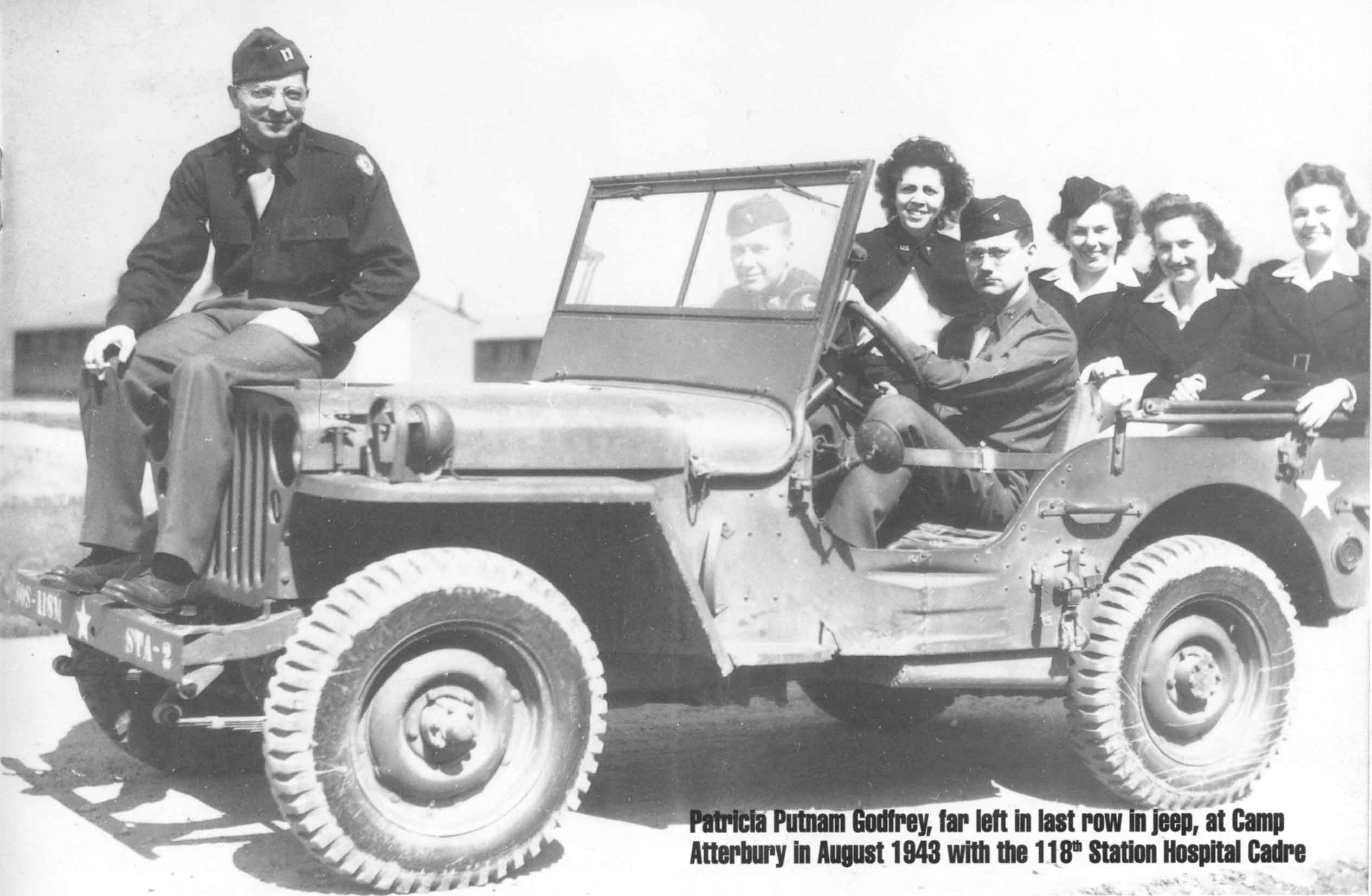
While at a nursing convention in Chicago, when "nurses were at a premium and the call was out," she signed up for duty with the American Red Cross. "That was the expectation of our generation," she says. "If you had the knowledge and skills you didn't hesitate." In September of 1942 she was training at
Camp Atterbury Indiana, and by August of 1943 she was on her way to Algiers. |
||
 1944 - outside a tent of the 108th Evacuation Hospital, France |
Margaret Miller Odor "The only way to get through a war is to feel like you're doing something to improve the situation. You feel like it was worth living through... " |
 1999 |
|
Her unit followed in Patton's wake as Allied armies moved quickly past Paris and through France, staying only four miles behind battle lines. `We were right close to the front," she remembers. "These young healthy soldiers would come in wounded and in rapid succession we would patch them up and move them to another hospital. We had great results with our surgery," she continues. |
||
 |
 |
|
 click on images for larger view |
||
| � 2007 James D. West - Indiana Military Org
All Rights Reserved Page Last Revised 01/09/2007 |
||

 Today, Mom is 85 years old. Her days from the WACs influenced her for her
entire life. Each morning when I was a child, I would see her doing
morning exercises. I did not learn until I was an adult that that
influence came from the WACs. Today, at 85, mom is still going strong.
She volunteers at St. Francis/St. George Hospital in Cincinnati, where she
wheels patients into their physical therapy. She hands out baby supplies
for Santa Maria to young mothers who do not have much money. She
volunteers at the grade school library that she started about 40 years
ago. In her free time, she bikes. She took biking up as a hobby in her
60's; today, she bikes about 40 miles at a time at a local park. If you
ask her, she would say that she is slowing down because a couple years
ago, she easily could go 50 miles on the bike.
Today, Mom is 85 years old. Her days from the WACs influenced her for her
entire life. Each morning when I was a child, I would see her doing
morning exercises. I did not learn until I was an adult that that
influence came from the WACs. Today, at 85, mom is still going strong.
She volunteers at St. Francis/St. George Hospital in Cincinnati, where she
wheels patients into their physical therapy. She hands out baby supplies
for Santa Maria to young mothers who do not have much money. She
volunteers at the grade school library that she started about 40 years
ago. In her free time, she bikes. She took biking up as a hobby in her
60's; today, she bikes about 40 miles at a time at a local park. If you
ask her, she would say that she is slowing down because a couple years
ago, she easily could go 50 miles on the bike.