Veteran recalls surviving the Battle of the Bulge, then dodging U.S. bombs in Germany as a POW
|
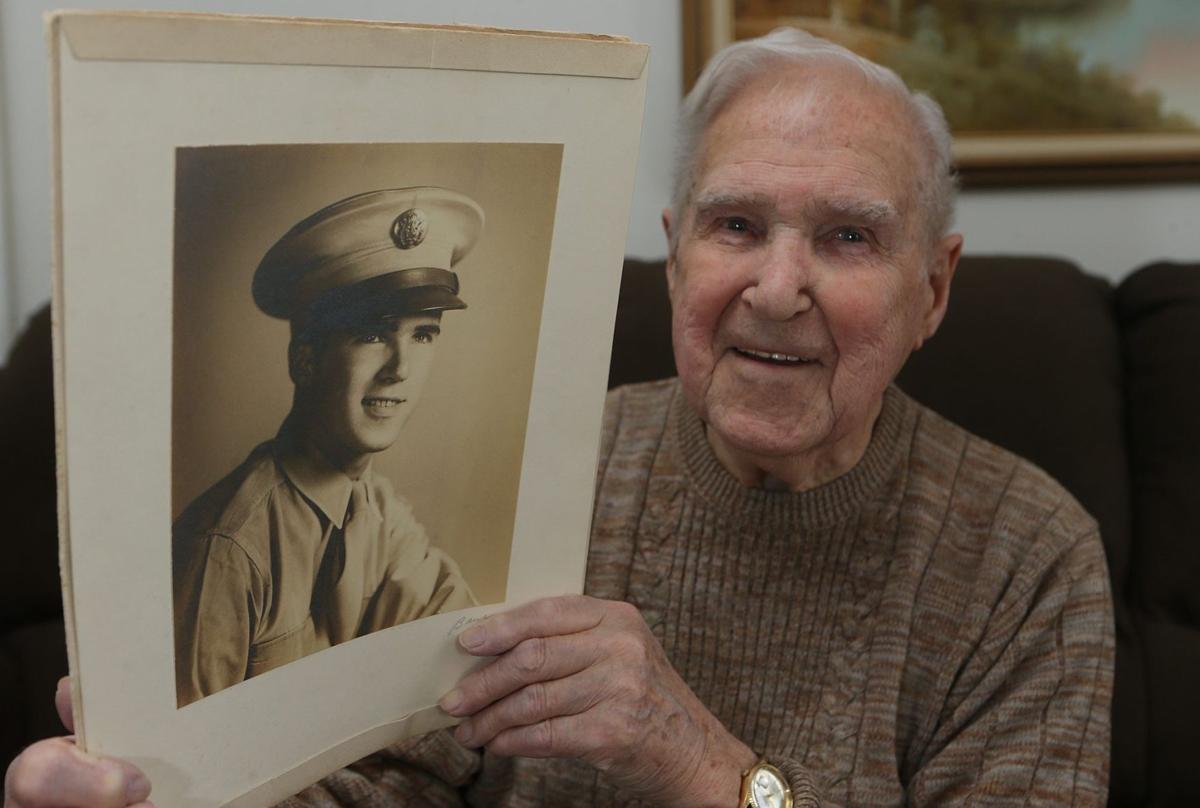
Robert E. Pope |
Veteran recalls surviving the Battle of the Bulge, then dodging U.S. bombs in Germany as a POW
Attending Bates College in
Lewiston, Maine, hoping to one day become a
physical-education teacher, Robert E. Pope received a
draft notice in 1942 that led to him put his physical
abilities to the test in combat, hauling a machine gun
across Europe.
But his biggest test of
physical endurance would come in surviving as a prisoner
of war. It happened just after the pivotal Battle of the
Bulge started Dec. 16, 1944. Pope and other members of
the Army's 590th Field Artillery Battalion had advanced
too quickly.
�Our battery had moved up
so fast to the front lines in the Ardennes Forest that
we were cut off from our supply lines,� Pope recalls,
�and on the night of Dec. 2, our commanders told us that
we were going to surrender in the morning because we
were surrounded.�
At daybreak Dec. 21,
German troops entered, from both sides, the valley where
the 120 soldiers were trapped. The surrender went
peacefully. �The Royal Air Force had bombed the
railroads, and we had to march in subzero weather for
100 kilometers to where the railroad had not been
bombed,� Pope says. �I have no idea where that was.�
But he vividly
remembers the forced march.
�We had very little to
eat, and what there was went to the guards. When we
would stop at a farm, we scrounged around to find
turnips, a carrot or anything else,� he says. �We
marched nine days before we were placed in railway
boxcars.�
That almost proved to
be a deathtrap.
�While we were waiting in
the boxcars, the train was strafed by U.S. P-47 fighter
planes that thought the train was carrying supplies,�
Pope remembers. �A shell came through the boxcar I was
in and killed the guy standing next to me. The guards
let us out, and we ran into a field of virgin snow and
we spelled out 'U.S. PWS.'
�We left out the 'O' in 'POW' because we wanted to do it fast before the planes came back. When the planes returned, they flapped their wings at us, recognizing that we weren't supplies � we were American prisoners.�
A couple of days later, he
and his fellow soldiers arrived at Stalag IV-G in
Oschatz, Germany, between Leipzig and Dresden.
�We were there for about
10 days for interrogation, then the privates and
private-first-class soldiers were put on a train and
taken to Leipzig,� he says. �� They put is in what was a
nightclub before the war that was in the suburbs. That's
where we stayed at night.
�Every morning, we got up
and had our meager breakfast, barley soup, then a piece
of bread and liver sausage to take with us.
�At night, we had barley
soup again. We boarded trolleys to the railroad station,
and then we would go out on flatcars to where the
railroad had gotten bombed out the night before and work
on it. If you haven't seen it, that is heavy work.�
The POWs would fill in
bomb craters with heavy gravel, lift replacement
railroad ties into place and install new sections of
steel train track. It was arduous work for soldiers on a
near-starvation diet.
However, the enemy didn't
care about that. The dimensions of the railroad track
were what mattered.
�After the inspector
measured to make sure the width of the track was right,�
Pope says, �we would pound spikes in to hold the track.�
On the night Feb. 21,
there were no air raids. �So the next morning,� he says,
�we worked in the city on trolley tracks. At noon, the
sirens went off, and a few minutes later, B-17 bombers
appeared, one wave after another for over three hours.
They were dropping 1,000-pound blockbusters and
250-pound incendiary bombs.
�We were not allowed in
the bomb shelters with the citizens and had to stay out
in the streets during this bombing. This raid virtually
leveled the city. There were fires all over, and the
city was demolished.�
Yet only a few POWs
perished, compared with the many civilians.
And if the day had not
already been trying enough, when the bombing concluded,
the trolley line that transported the prisoners had been
destroyed, Pope says, �and we had to walk 12 miles back
to prison.�
After that, the misery
continued until the Germans combined Pope's unit with a
larger contingent of prisoners. They moved about like
Gypsies, going from one farm in the countryside to
another, in search of food and water.
�Then one day, when we
were at a farm and told to fill some empty milk cans
with water, we went to a farmhouse across the street,�
Pope says, �and when we were behind it, we realized
there were no guards who could see us, and we went out
through the woods behind the farm until we came to a
road and started walking on it.
�We walked for 36 hours.
At one point, we saw dust in the distance and hid. It
was a good thing. A German halftrack came by with SS
troops, and they would have killed us. Then as we came
up by a farmhouse, we saw a German soldier on the porch
kissing a young woman.
�There was a fork in the
road, and we didn't know what to do. We saw that the
soldier's gun was against the house. So we yelled,
'Which way Americanos?' And the German, without breaking
the embrace, pointed us in the right direction.�
A short time later, there
was more dust, but this time, it was being kicked up by
the wheels of an American Jeep.
�A captain and a sergeant
were in the Jeep,� Pope says, �and they asked us if we
came from a group of prisoners, and we said, 'Yeah,
there's about a thousand, and they are 36 hours back on
that road.' �
The next day, a convoy
was sent, and the other prisoners were liberated.
For Pope, the physical
trial had been intense. He had gone into the Army
weighing 175 pounds and was now 125.
�At Camp Lucky Strike in
France, they had full breakfast, lunch and dinners and
had eggnogs in between the meals,� Pope recalls, �and
when I came home, I weighed 155 pounds � but I looked
pregnant because it went on my stomach.�
His psyche, he added, had
taken a pounding from the trials of war, but he resolved
to move forward, telling himself, �That was my past. I'm
going to work on my future.�
His dream to teach
physical education never panned out. He eventually
settled in Western New York and served as a fundraiser
for various building projects, including structures at
Roswell Park Cancer Institute and what is now Women &
Children's Hospital.
But his biggest
accomplishment, he says, was raising money for the
construction of Millard Fillmore Suburban Hospital.
�I don't consider myself a
hero,� Pope says of his wartime service. �I consider
myself a survivor.�
Robert E. Pope, 90
Hometown: Englewood, N.J.
Residence: Clarence
Branch: Army
War zone: Europe
Years of service: 1943-45
Rank: Private first class
Most prominent honors:
Prisoner of War Medal, European Theater Medal
Specialty: Machine-gunner
|
| Source: Robert E. Pope, by Wayne Dunn 12/09/2020 |
 Page last revised
12/09/2020 Page last revised
12/09/2020James D. West Host106th@106thInfDivAssn.org www.IndianaMilitary.org |