THE 113th F.A. Bn. Disaster
15 June 1944
Upon visiting the Normandy American Cemetery overlooking Omaha Beach
and the English Channel, I noticed on the "Wall of Missing", the
names of 18 men of the 113th Field Artillery Battalion. I made
inquiry at the Cemetery office, as to whether they had any
information or knowledge of the reason for these names being on the
"Wall of the Missing". There was no reasonable answer to my inquiry
by the staff there.
For those not familiar with the organizational set-up of this
Field Artillery Bn., here is a synopsis of the situation.
The 113th F.A. Bn. was a 155 mm howitzer unit, and was in
Division reserve most of the time. This meant that they would
normally emplace their guns 1-3 miles behind the front lines,
depending on the situation. This was a relatively "safe" position to
be in.
These men were declared "Missing in Action" on 15 June, 1944.
This was the very first day that the 30th Division was committed to
actual combat. We questioned the fact that with the 113th F.A. Bn.,
far to the rear of front line action, how could it be that these men
were declared Missing in Action? Were they taken prisoner? Not
likely, as they would be too far behind the front lines. Were they
struck with a German artillery barrage and decimated? Not likely, as
there certainly would have been some evidence of bodily remains in
the area.
However, little did we know at that time, that on 15 June 1944,
the 113th F.A. Bn. was still enroute across the English Channel, and
had not yet disembarked on Omaha Beach.
Little did we know then, and as time - years-- went on, nothing
was ever said publicly about this discrepancy, although members of
our 113th F.A. Bn. were present at our Reunions, and the matter was
never openly discussed.
Some time ago, I was asked for information on the
disaster of the 113th F.A. Bn. while crossing the English Channel on
or about 15 June 1944, but had to plead ignorance and had to reply
that I did not know about, nor had I ever heard of such an incident.
How many of you have ever heard of the "Slapton Sands" incident?
Perhaps no one, until in very recent years ! Well, everyone was
sworn to secrecy in this incident, but the incident concerning the
113th F.A. Bn. was not as nearly as disastrous as that of "Slapton
Sands", nor were any of the personnel sworn to secrecy. But, there
was little ever said, and nothing ever published on it except one
brief mention of it buried in a short paragraph in the 30th Division
History, "Workhorse of the Western Front".
This is a story that every one should be aware of and to give
credit for heroism that has long gone ignored and where it is due.
In order to get as much detail on this incident, each known
survivor of the 113th F.A. Bn. was surveyed and many replies were
received, which have been developed into this account of the
disaster.
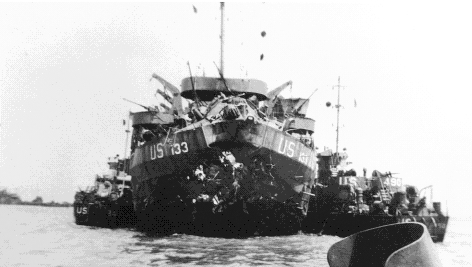 On 14 June 1944 the 113th FA Bn. personnel & equipment were
loaded onto LST #133,
and by late afternoon were ready to sail. The HQ Btry. vehicles were
loaded on topside, and the vehicles and equipment of the three
firing batteries were loaded below. On 14 June 1944 the 113th FA Bn. personnel & equipment were
loaded onto LST #133,
and by late afternoon were ready to sail. The HQ Btry. vehicles were
loaded on topside, and the vehicles and equipment of the three
firing batteries were loaded below.
The LST #133 left Southampton in the early evening, and slowly
followed its charted zig-zag course across the English Channel
through the night.
The men of the113th F.A. Bn. settled down for the night to get
some "sack time" in order to be rested and ready to go once they
reached Omaha Beach. In the early hours of the morning of the 15th,
it was announced that breakfast was being served: hard-boiled eggs,
hardtack bread & coffee!
After eating, the men were lined up and filing past the G.I.
cans, located in the fantail of the LST, indulging in the necessary
ritual of washing their mess gear.
At this moment, the LST was struck by a free floating mine that
had somehow escaped detection by the underwater engineer teams who
had been assigned to clear the designated paths to Omaha Beach for
problem free landings.
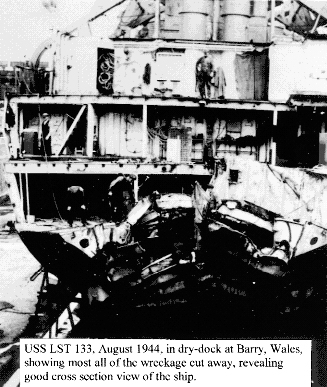
The mine struck in the fantail area, shattering it and the guns
and equipment mounted there, and blowing many of the men into the
water, killing most of them. Some survivors were recovered, and a
few bodies were recovered, but there were only 2 known killed, who
are buried in the Normandy American Cemetery, overlooking Omaha
Beach and the English Channel, where they lost their lives.
Additionally, there were 18 men of the 113th F.A. Bn. declared
Missing in Action, and their names are carved into the marble
tablets in the collonade on the Wall of the Missing. Possibly a few
more men whose bodies were recovered, may have been repatriated back
to the United States, of which there is no record available.
The Naval crew in charge of the LST, went about their assignments
in a most professional manner, checking first on injuries and aiding
them as best that they could, then checking the ship to assess its
damage to seams etc. To determine its flotation ability before
giving orders to abandon ship. The LST was declared to be seaworthy
for a short time, just enough to allow it to be towed to the Beach,
as it was without power. Two tugs came along side, tied on to buoy
it up, and towed it as close to the Beach as they could. It was
still in relatively deep water, and it was necessary to wait until
nearly midnight, when the tide was low, so that they could unload
the equipment.
One of the survivors said "I was just getting out of my sack when
my mess-kit went flying by my head. I remember a lot of men were
wounded and crying"
A recollection by Col. Bill Carlton, C.O. of HQ Btry:
About half way across the English Channel, our LST struck a mine
with its propeller. HQ, and the 3 firing batteries were aboard. My
Hq. Battery trucks were parked on the topside, and the firing
batteries were below. We were at breakfast, and the HQ G.I. cans for
washing mess kits were in the passageway circling the rear of the
pilot house, directly opposite the fan tail deck on which two .50
cal. AA guns were mounted. The detonation sent the fan tail up over
the pilot house, and it fell, striking and caroming off the side of
a GMC LWB wire truck onto the deck. This huge warped piece of steel
fell on my senior wire section Cpl. The shock had knocked him to the
deck on his side, ands where he was lying underneath the huge flying
piece of steel, or he would have been sliced in two on the spot. A
half dozen of us heard his cry for help and managed to raise it
enough to pull him out from under it. He was cut deeply between the
hip bone and the lower rib cage, and he died a few hours later.
There was much confusion and panic, as it began to dawn on us
that many familiar faces were missing. The machine guns and gunners
were, no doubt, atomized-as well as many who were washing their mess
kits. The fire direction center crew were at the G.I. cans, and all
were lost, as well as the others. HQ Btry lost 12 men, most of them
NCO's filling critical assignments. I found only the wounded wire
Cpl. And the body of a truck driver on board.
Writing to their next-of-kin was my hardest assignment of WWII,
unless it was the reopening of old wounds a year later when I had to
write again to say that they were considered to have been KIA!
Since the ship had a dangerous crack about midship, the Navy kept
sailors lying on their bellies on topside, to give the "Abandon
Ship" alarm if they saw the crack widening, which was not at all
reassuring. A couple of tugs tied up alongside, and offered to take
us back to Southampton, but our Bn. C.O. said "Hell No! We are over
half way across the Channel. Take us on in"! They waited for high
tide, and shoved us as far as they could before cutting us loose,
where we landed on a sandbar, then had to wait until about midnight
for low tide, when the ramps were lowered and we were able to unload
the vehicles and equipment.
A recollection by Capt. Van Heely
At about 0800 on 15 June 1944, a bright sunny morning, LST #133
was part of a convoy enroute to Normandy from England, and was about
in the middle of the English Channel. The ship was lagging some
distance behind the rest of the convoy.
On either side of the fantail of the LST were placed 55 gal.
Drums into which the men were to empty their garbage. The breakfast
meal had been served and many of the troops were eating at the stern
of the ship and emptying their garbage into the 55 gal. Drums. The
men of the fire direction team of the 113th F.A. Bn. were buddies
and were all eating together at the stern of the ship.
There was an explosion and the ship seemed to leap out of the
water. A large portion of the stern of the ship was blown away. Part
of the wreckage landed on the forward portion of the ship, killing
and wounding some personnel and damaging some of the deck cargo.
All of the men who had been at the stern of the ship were lost
and only a few bodies were found. The ship sat dead in the water,
and while shortly before, there were no other vessels in sight, now
there were boats all around us. Welders came aboard and
welded steel plates at places where the steel deck had cracked.
The Naval personnel asked Lt. Col. E.F. Griffin, C.O. of the
113th, if he wanted to go back to England. Lt. Col. Griffin replied,
"We came here to fight in France, and that is where we want to go"!
LST #133 was towed to Omaha Beach to the point where it ran aground.
The water was too deep to disembark at that time, and we waited
until 2330 when the tide was low. With about 18 inches of water, we
were able to leave the ship. It was unfortunate that we lost about
30 good men, but thankfully the ship did not sink and we did not
lose a whole Battalion, with their equipment.
On the Wall of the Missing at the Normandy American Cemetery are
listed the names of 18 of our comrades lost in this incident, and
declared Missing in Action. Two others who were killed in Action in
this incident and were recovered, are buried at this site
overlooking Omaha Beach.
A recollection by Col. Abbott Weatherly, C.O. Btry A.:
I was the C.O. of A Btry while they were crossing the Channel,
and we were on the LST just ahead of the one that was hit by the
mine. We had been warned that we were passing through a mine field,
and then we heard the explosion of the LST to our rear, and then saw
a lot of debris of the ship and a huge mass of water being blown
into the air.
We could not stop to help, and we had to keep going!
A recollection by Alton J. Dahl
On that morning, I was chatting with Cpl. Jimmy Davis and
preparing to accompany him to breakfast. I had been kidding him
about the dangerous job he'd have in combat as a runner from the CP
to the forward observer. He replied that he would live long enough
to look on my grave ! This was all in good spirits, and then he said
"Let's go eat". I said "OK", but then I decided to forego those
famous "hard boiled eggs". He left and I never saw him again. We
also lost Jimmy Collier, of our fire direction center, of which I
was a part. From information that I received at the time, the LST
struck the mine and destroyed the mess area where many of the guys
were eating breakfast.
A recollection by Bill Fuller:
With regard to the incident of the damage to an LST carrying
elements of the 113th F. A. Bn. here is my recollection: I am
reasonably sure that the incident occurred on 15 June, as that was
the day that we landed on the shore of France. Earlier that day as
we convoyed across the Channel, I observed one of the LST"s move to
the left of the channel. Shortly thereafter there was an explosion .
I was told at the time that the LST, carrying Battery C, and other
elements of the 113th, moved from the center of the channel to the
left side, so that the Captain could verify the marking on the buoy
that they were passing. Unfortunately, it appears that a mine had
drifted into that part of the path we were following and again as I
was told at the time, detonated under the stern of the LST. I never
knew how many members of that Battery were injured or lost, but I
heard that it was several. There were also significant losses among
the crew of the LST. I understood that their quarters were in that
region of the ship.
A recollection of Bill Adams,T/Sgt. Hq. Btry., Personnel Section:
I was the T/Sgt. In the Hq. Btry. in charge of the Personnel
Section of 16 men, handling personnel records, payrolls,
courts-martials, daily morning reports etc.
The Personnel Section of the Hq. Btry, left Southampton, England
on or about14 June, having embarked on an LST which followed the LST
that was damaged by an enemy mine, and allegedly suffered a loss of
about 30 men. This carrier, to my knowledge, was the LST carrying
the three batteries of the 113th F.A. Bn.
Upon reaching the Beach of Normandy, France, we set up in the
vicinity of Isigny, France. Our first directives were to prepare a
report of the men missing in action. After a period of time, we were
directed to prepare a report of the men killed in action.
Thus the "mystery" of the 18 names of Men inscribed on the Wall of
the Missing finally comes to light.
 It
is felt that this is a long overdue and very limited description of
this disastrous incident that befell the 113th F.A. Bn, never before
told, and is told now to memorialize and honor the men who lost
their lives in this very first of disastrous events that were to
follow the 30th Infantry Division throughout its combat experience
in WWII. It
is felt that this is a long overdue and very limited description of
this disastrous incident that befell the 113th F.A. Bn, never before
told, and is told now to memorialize and honor the men who lost
their lives in this very first of disastrous events that were to
follow the 30th Infantry Division throughout its combat experience
in WWII.
This data was furnished by several of the men and Officers of the
113th F.A. Bn, who were involved in this disaster. No doubt there
are many more details that occurred during this incident which are
not covered here, and we would like to hear of them so as to
incorporate this article in our Web site with as much detail as
possible.
Frank W. Towers
Exec. Sec-Treas.
30th Inf. Div. Assoc.
THE SEQUEL IN 2002
Now, after almost 58 years, some more of the details
of the Disaster of the 113th F.A. Bn. are coming to light.
The Ship concerned in the foregoing account was LST #133,
commanded by Capt. F. E. Richards on 15 June 1944, and this is the
first and only official documentation that confirms this incident,
that has ever been uncovered.
The original report by Capt. Richards, dated 18 June 1944,and some
photos of the damage incurred in this incident, which were taken
immediately after the LST #133 had been towed back to Southampton
for repair, have been obtained from one of the crew members, and is
published as follows:
|