|
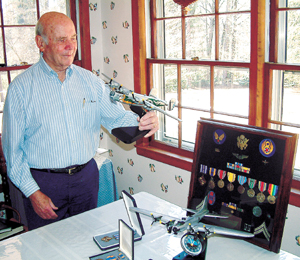
William "Bill" Rice He had bird’s-eye view of WWII Greenwood man piloted B-24 bombers during war |
||
|
March 10, 2005
Instead, as a member of the U.S. Army Air Force, Rice spent his time in combat in the air, piloting a B-24 bomber and dropping bombs on enemy targets to help to clear the way for an Allied victory in Europe. Though he was not on the ground, Rice, a captain by the age of 21, witnessed the violence and destruction of war from the air. He watched as hundreds of fellow soldiers were shot down from the sky around him, and Rice said he never planned on making it through a mission without an injury. In fact, he never imagined he would make it through the war alive. Rice, now 83, a native of Georgia, moved to Asheville in 1925. As a young boy growing up during the Depression, Rice said he sold newspapers on the street corner to help with family expenses after his mother’s death in the early 1930s. In June of 1940, Rice graduated from high school, and because he couldn’t afford college, he decided the military would be a good option for his future. “I was an adventurous young person, and I didn’t have the opportunity to go to college, so I joined the North Carolina National Guard on my 18th birthday,” he said. “A month later, they called us into active duty.” In September, Rice was ordered to report to Ft. Jackson in Columbia for basic training with the combat engineers of the 30th Infantry Division, nicknamed the “Old Hickory” Division after Andrew Jackson. “It was pretty rigid training. They started out with close order drill, and they taught you military courtesy and military discipline,” he said. “They wanted you to know that when you did something wrong, you would be punished for it. But we were all young and eager, so most of us did what we were supposed to.” After weeks of rigorous training, Rice became unhappy with his duties within the combat engineers. He bought a second-hand typing book, and he taught himself how to type using the company clerk’s typewriter at night. In the summer of 1941, Rice was promoted to the rank of corporal as the company clerk with the division. When it became apparent that the United States would enter the war after the attacks on Pearl Harbor, Rice said he knew he didn’t want to remain with the combat engineers. Instead, he wanted to be a pilot with the Army Air Force, and he took the entrance examination for the program. “There was no one more surprised than me when I passed it because at that time, you had to have a junior college education,” he said, laughing. “But I had gone to such a good high school that I made one of the higher grades in that unit.” In the fall of 1942, Rice was ordered to report for his first round of pilot training at an air base in Montgomery, Ala. He trained for months on AT-10 aircraft and twin-engine planes, and by May of 1943, he had completed advanced pilot training in Seymour, Ind. He received his wings and was commissioned as a second lieutenant. At an airbase in Smyrna, Tenn., Rice began preliminary training on the airplane that he would fly his entire time in combat – the B-24 Liberator, one of the largest four-engine bomber planes at that time. When it was fully loaded with gasoline and bombs, the B-24 weighed close to 28 tons. Rice said learning to fly the plane was both exciting and stressful. “It takes quite a bit of skill to fly those planes. They are harder to fly than the planes people fly today because they weren’t as sophisticated, and you didn’t have as many automatic controls,” he said. “To get in this airplane, you had to go up through the nose wheel compartment. The wheel would come down and the doors would open. You would have to be athletic and pull yourself up through there.” In July of 1943, when his training in Tennessee was complete, Rice headed to Boise, Idaho, where he first met the nine other men who would serve as his crew throughout his time in combat. “We were all kids. The oldest man on the crew as 32. We had a pretty motley crew, but we were all dedicated to each other,” he said, adding that, as flight commander, he took his job very seriously. “One of the rules I had on that crew was that the men had to associate with each other. If they went (anywhere), they went together,” he said. “If we were going to die together, we were going to live together. I thought that was a pretty good policy because we really got to know each other and depend on each other for support.” In August, the crew left for an airbase in Pocatello, Idaho, where they remained until November. It was at this airbase when Rice’s crew began practicing firing on other aircraft and learning how to bomb targets from thousands of feet in the air. As WAF (Women in the Air Force) pilots pulled empty aircraft sleeves behind their own planes, Rice and his crew would fire on the sleeves using 50-caliber machine guns. He said he can still remember how loud – and destructive – the guns could be. “You can’t imagine how damaging those guns were,” he said. “When you would get 10 machine guns firing, that airplane would just shake.” In November, after a stop in Kansas, Rice was ordered to fly to Florida. On the way, Rice said he deviated from his course in order to fly over Asheville, where he “wiggled” his wings over the courthouse. From Florida, Rice and the men eventually landed in Natal, Brazil, after a few stops to refuel the large plane. The men had received sealed orders for their deployment, and when they opened the orders, they realized they were headed to Europe. “The orders gave us instructions about our uniforms and what to take with us. If we were going to (the Pacific), we were to keep our summer uniforms,” he said. “But we kept our wool uniforms, which indicated we were going to England.” Rice said the crew departed from Natal in the middle of the night, and experienced a rough 2200-mile flight across the Atlantic before landing safely in Senegal. “For seven hours, we were in violent weather – it was just horrible,” he said. “That airplane would hit updrafts and downdrafts going 500 mph, and it wasn’t built to fly like that.” The crew made one last stop in Morocco before heading to England, but due to flight regulations, they were not allowed to fly in the airspace above Spain or Portugal. “We had to fly out over the Atlantic, and that was when we first met our enemy – the German fighter planes. They had come up through France and tried to interrupt our flight,” he said. “Fortunately, we could see them coming in the distance, and we got in cloud cover to avoid them.” The crew eventually arrived at an English replacement and distribution center, where American troops were returning after flying bombing missions. “They would put those men in the same barracks as us, and they would have horrible nightmares that would wake us up and scare us to death,” Rice said. “They were fighting those battles every night, and I hadn’t (been in battle) yet, so all it did was scare me.” Rice and his crew were assigned to the 389th Bomb Group as part of the 8th Air Force, and they reported to Norwich, England. In March, the 10 men flew their first daylight bombing raid over Germany. The battles were fierce, and Rice said he expected to be killed on every mission. “I knew I wasn’t going to survive that war. I never even pretended that I was going to. It was like getting a death sentence every day,” he said. “I hate to think about how many people whose death I was responsible for – there is no way to know. But I wasn’t the only one trying to get rid of people. They were trying to get rid of me, too. There is nothing puritanical about war.” On one particularly frightening mission, he thought his co-pilot had been killed when an enemy casing came through the windshield, hitting the man in the shoulder. “He went sailing back almost to the bomb bay, and I knew he was dead,” he said. “But he got up and sort of shook it off and got back in his seat. That was a scary moment.” On June 5, 1944 after three particularly deadly missions that resulted in heavy losses from his unit, Rice left the air base for a week of mental recuperation. But just hours after arriving at the Red Cross station in Norwich, Rice’s vacation came to an end when he was ordered to return immediately to his base. He was needed for a June 6th mission over Caen, France, a town near the coast of Normandy, where Allied troops were beginning the invasion that would become known as D-Day. “We were softening the German forces for the people that were going in on the ground,” he said. “I really felt like I was with heroes – those guys that went in on that beach really had a tough job. There weren’t a lot of survivors that first day.” Rice completed his last mission on Aug. 14, 1944, just two days shy of his 22nd birthday. During his six months as a pilot in combat in Europe, Rice flew 30 missions – each with his original crew – and was promoted to the rank of captain. He remained in England to perform non-combat flying missions, and he finally returned from Europe in December of 1944. When he was discharged from duty in September of 1945, Rice finally had the opportunity to attend college. He graduated from medical school at both Wake Forest and Duke universities, and in 1962, he moved to Greenwood, where he practiced anesthesiology until 1988. Rice said he considers himself lucky to have survived the bloodiest war in history. “I’m just surprised that I’m here. They had every opportunity in the world to get rid of me,” he said, but he added that he was proud to serve his country. “We knew we had to do what we were doing, and we were very patriotic and very gung-ho about it. Just getting to fly those airplanes was phenomenal. I never expected to get to do that.” (By MEGAN VARNER, Index-Journal staff writer) |
||
| Back to Class 43-E | ||
 James D. West
 www.IndianaMilitary.org Host106th@106thInfDivAssn.org |