|
Belgium and the Fight |
|
After breakfast we broke camp and soon we were back in the trucks and on our way over pitted, rough roads. We passed though interesting small towns and battered villages, past burned skeletons of tanks and trucks in the roadside ditches. Our trucks wound through the mountains of Eastern Belgium and Luxembourg passing snow covered evergreens that looked like a Christmas card. It was a beautiful scene. The area reminded me of being back in Connecticut. We passed through St. Vith, with people waving to us as we drove by and giving the Vee for Victory sign and we returned them. In a little while, we were over the German boarder where we stopped.
We then marched through fog and thick snow to our positions in the area that was the called the Schnee Eifel, a wooded, snow covered ridge overlooking the village of Sellerich. It was late in the afternoon of the 1lth of December. The veteran 2nd Infantry Division, who we were relieving, passed us heading back for the trucks who were taking them to a rest area in the rear. Then they were going join in a planned attack to capture the Roer River dams to the North.. It was believed that these dams could be opened by the Germans to flood the area that would be in the path of an Allied offensive, so their capture was a high priority.
Red triangle points to area occupied by my Company I, 423rd Regiment, 106th Division
When planning offensives, part of the
strategy is to overpower the opponent with as much force as one can
muster. The Allied troops were covering a long front from Holland to
the Swiss border. Our Division was the last
division to leave the USA, there were no more divisions left. With such a
long front there just were not enough reserves to provide the power needed
to mass for an offensive and still be able to maintain a normal
distribution of manpower to safely hold the occupied positions in the
line. So troops had to be taken out of the line to mass an offensive. Our
division was to occupy a “quiet” area, an area that was some twenty
two miles long that should have been a five mile front under normal
conditions. The 2nd Division had requested that part of the line that
formed a salient into Germany be pulled back to shorten the line, to make
it more easily defendable and reducing the exposure to encirclement. Our high command refused the request because it did not want to give up its salient position into the Siegfried line. A position that later could be used as a jumping off point for a future offensive to reach the Rhine river. In addition, our Army high command was sure that the Germans were in no position to mount an offensive of their own. There was little contact made by us with the departing 2cd Division except for a very brief meeting and tour of the front by the officers.
The following in italics copied from the story of the 106th Div.
"This was a quiet sector along the Belgium-German frontier. For 10 weeks there had been only light patrol activity and the sector was assigned to the 106th so it could get some experience. The baptism of fire that was to come was the first action for the 106th. For many of its men it was the last. The little road center of St. Vith had seen war before. It was through St. Vith that Nazi panzers rolled to Sedan in 1940; German infantry marched through it in 1914. But it never had figured as a battleground such as it was to become in this fateful December of 1944. During the night of Dec. 15, front line units noticed increased activity in the German positions."
Actually our riflemen were calling back on their phones to the command post on Dec. 13 and 14th. On the 15th the reports that were coming from our forward posts said the noises sounded like tanks out there. The command post relayed all the messages up to Battalion and it went on up through Division HQ in St. Vith. The answer that came back on all the nights including the 15th was, that your men are hearing things, it's your imagination. They wrote us off as green inexperienced troops with the jitters. Later I read that one of the answers that we received was “they are playing records to scare you!” That says a lot about our “intelligence staff.” that were back in France.
My mortar squad was located along side of a dirt road in a dug out hole that was built up and covered with large logs and dirt. There was an opening facing the road for our mortars so we could shoot over the trees on the other side. Our position was the last one for our company along the dirt logging road. We were near a pill box that was part of the West Wall or what the Germans called the Siegfried Line. We took turns manning that post day and night. A patrol would walk the road every few hours to make contact with the next unit that was a considerable distance away. Some of these gaps in the line were a few miles across. You could move a company of men through one and nobody would ever hear them. German patrols would be out there often. One night one of their police dogs broke away and was chasing something down the road and the dog was shot as it ran past our position. In the early morning hours of Dec.16th all hell broke loose. We were under very intense artillery and rocket fire. We hugged the ground in our log shelters for what seemed an eternity (probably about a half hour) but even with the tree bursts my squad made it through OK without any casualties. As the morning progressed we could hear occasional shooting and shelling to our front and flanks. Slowly the firing sounds started to come around to the rear. The heavy artillery blasting cut the telephone lines to our front so we didn't know what was going on and we had no requests for mortar fire. In the late afternoon some of our rifle platoons appeared coming out of the woods and going to our rear. When asked were they were going we were told they were going to set up positions in the rear. Soon we received orders to move some of our mortar to the opposite side of the road facing the rear and to prepare the site for firing. We knew then that we were surrounded. No attack came that night although we could hear gunfire in the distance to the rear of our position.
The next morning on the 17th of December, we
were told that we were going to break out of our encirclement. We were
told to destroy anything that could not be carried forward into the
attack. Blankets, overcoats, excess ammo, etc., were burned or blown up.
Rumor was that we were headed toward St. Vith and we would draw new
supplies there. Our company commander was notorious for not passing
information down to his men. Most of the time we didn’t know where we
going except down the road or the path we were on.
(A few light tanks or armored vehicles I
believe that were from the 9th Armored came into position on the road.)
With Jeeps, and our trucks ready to follow we started to march out in
columns. Ahead of us were the rifle platoons leading the assault.
Occasionally we would stop as we heard shooting ahead of us but w received
no calls for support and we soon would resume our advance. Around noon we
passed a German field kitchen, it’s pots were boiling over, raising
columns of steam as the contents spilled into the fire as they were left
in haste by the retreating German troops. We were surprised and felt
elated at what was seeming to be such an easy victory! Practically no
resistance, we did not know that the main enemy forces had decided to
bypass us and had headed on toward Schonberg and St. Vith.
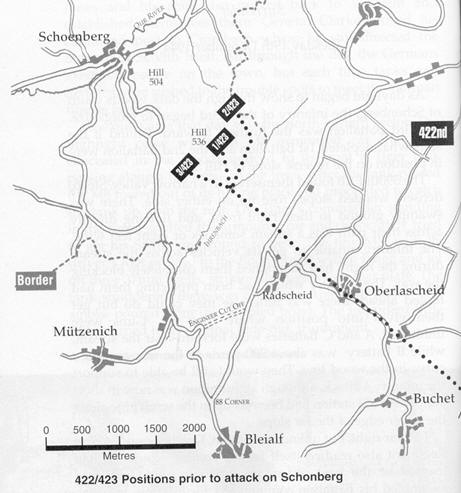
In Mid afternoon we were approaching a town. It may have been
Radscheid about one and a half miles from Schonberg. The road we were
following curved up hill 536. It was a high hill with open fields on each
side and woods to their rear. As we approached the crown of the hill the
sky opened up and we were the targets of a vicious artillery and anti
aircraft batteries of fire that rained down a tremendous bombardment that
seemed endless. In a few minutes everything on the road was destroyed. We
had dived into whatever ditch or cover that we could find along the side
of the road. As the shells continued to explode around us I was very
frightened. How could I survive out in this open space? Surely a piece
would find me in this shallow ditch. When the fire finally lifted we ran
into the woods to regroup and take up defensive positions. This may have
been the artillery battalion that was moved out of Schonberg to join into
the German counterattack. In the Army’s history of the battle, it was
mentioned there were heavy traffic jams in Schonberg due the large number
of armor and panzer units moving through the town. Therefore only one
German battalion was able to get into position to hit our road. Well, that
was all they needed, because we didn't have a single vehicle left.
All we had was what we were carrying on our backs. We reassembled in the woods to the side of the road and continued our advance toward Schonberg. We were on hill 536 where we ate our "K rations and water from our canteens and we stopped for the night.
The next morning on the 18th, we refilled our canteens with water taken from a brook and put in purification tablets. (I believe they contained an iodine compound.) We continued on our advance to the next hill 504. (I had no idea what hill number we were going to at the time, the only command we got was “let’s go”, and we followed the others.) We could hear the rifle fire of the rifle platoons ahead of us but they were not in need of much mortar support. We occupied hill 504 that was our objective outside of Schonberg. We were wondering if we were going to get a resupply of food and munitions. Maybe we would get the 424th Infantry reserves or 7th armor support from St. Vith to help us. Nothing came, we were on our own on this advance. We spent another night hungry and freezing in the woods but the Germans left us alone. (Actually, transport planes had left England with the supplies we needed that were going to be air dropped, but due to a foul up in communications in the Air Force command, they had to be diverted to France. The 7th Armor had been ordered to come to our support but turned back a few miles from reaching us. They decided they did not want to risk the loss of tanks and fell back to stronger positions in the new line being formed with the 424th Regiment.)
The morning of the 19th found us advancing again in another attempt advance into Schonberg only to withdraw and then move on to try again in another location. About mid afternoon my squad and another under Sammy Pate were called upon to lay down some mortar fire for our rifle platoons that were ahead of us. There was a small clearing in the woods that would allow us to set up the mortars. I ran out into the field and I dropped the gun-sight box at the location where I wanted my crew to set up the gun. Then I continued to run ahead to take up a position to observe and to direct the mortar fire. (At this point I had no idea what I was going to be looking for! As usual there was no information from our officers, just to get out there. I was hoping I would see the target as I got to the end of the field. Anyway Sammy would be out there with me I thought and we would find it. I think somebody might have said it was a German 88 artillery piece.) While running to about the middle of the clearing, with my binoculars now pulled out from my jacket and hanging from my neck, I came under sniper fire from the left side of the field.
I dove for the ground.. Each time I raised my head attempting to see where the fire was coming from, the sniper would fire at me, the bullets whistling by my helmet. When the sniper wasn’t firing at me he was firing to my rear, at Sammy I thought. I had assumed that Sammy was behind me and I thought that he was doing the same thing that I was doing. I don't know how long I was out there, but it seemed like a very long time. Someone from the rear yelled not to move and to keep my head down. Finally I heard a small explosion that came from the direction of where the sniper was and then a call came from the rear to crawl back. The sniper had been killed. I began to crawl back through the snow to the cover of the woods when I noticed that Sammy was not moving, he was lying perfectly still. As I drew next to him my worst fears were confirmed, he had been shot right between the eyes, the sniper's aim was flawless. Sammy was white and there was nothing that could be done. He was dead.
As I came back and reported Sammy's death, a deep sense of guilt came over me for still being alive. It could have just as easily been me. We were both out there alone I thought, looking up, trying to spot where the fire was coming from, but for Sammy the bullet found its' mark. I remember asking under my breath, Why not me, Lord? Why Sammy? A ghost that was to haunt me for over fifty years.
For years as I remembered Sammy, I felt that I should tell his family what happened. All I knew about him was his name and that he came from Texas. That wasn’t much to go on. One evening in late January 2000, I was reading an E-mail note from John Kline, editor of the 106th Infantry Division Association “Cub” magazine. He was describing finding the grave of one of our Regiments’ soldier in Belgium. I wondered if John could check out that cemetery to see if Sammy was there. I asked him if he could find any information with his knowledge and access of the military archives. He checked out the cemeteries but did not find him. He said it was possible that his family had his body returned to the USA.
John then gave me the addressees of some the members of my unit, Company I. This turned out to be a gold mine source of information. He connected me with Richard Peterson my mortar section leader and other members of Sammy’s mortar squad. A continual flow of internet, mail and phone massages with new information followed and later reunions with the men of my section. Two of Sammy’s crew, Harold (Sparkie) Songer and Murray Stein were able to tell me of what really happened in that field that afternoon
The following is what Sparkie told me. When the sniper started shooting, Colonel Cavender our Regimental commander was in our area and he spotted the sniper location. None of the crews had left the woods yet and Sammy was close by. He told Sammy and our crew to “Get that God damn sniper that is in those bushes over there”. Sammy and his crew moved out into the clearing to set up the mortar. The range was too short to use the standard elevating mechanism. Sammy, my squad leader was trying to aim the mortar tube by elevating the tube by holding it vertically with the bottom resting on the ground. It was while he was doing this that he was killed by a bullet that hit him in the temple. At the same time, I was hit but the bullet lodged in my mess kit spoon that was in my shirt pocket. Then another mortar man (Stein) and I grabbed the mortar and dropped three shells in the area of the sniper, killing him. The sniper firing that I heard was not just at Sammy and me but at Sammy, his gun crew and me!
When Sammy was in England, he was a roommate of Sgt. Richard Peterson. He decided to write his Will. He had Dick witness it, so Dick signed it and then put his home address on it and Sammy sent it home. Later after Sammy’s parents received the news of his death they found Richard’s’ address on Sammy’s will and they contacted his parents. After Richard came home he wrote to Sammy’s sister. In the 1950’s Harold Songer, who was with him when he was shot, visited Sammy’s mother, family and girlfriend in Houston and told them how Sammy had died.
It was in February 2000 when I first knew of what really happened. I felt a load come off of me and the ghost was gone as I knew someone had contacted the family. The blast that I heard before I crawled back was from Sammy’s crew. By the time I received the call to return and then when I started to go back, they were all out of the field and back in the woods, except for Sammy. Now I know not only what happened that afternoon but who it was that may have saved my life
Shortly after coming back from
the field there wasn’t time to discuss what happened as we were now on the
move again. I didn’t know it then, we were not retreating or trying to
escape the Germans but we were advancing in preparation of an attack on
the town of Schoenberg. As I said before, our Captain told us nothing of
what was going on.
Soon we were nearing Schonberg. Company K and our Co.I were coming down the side of Hill 504 approaching the outskirts of Schonberg when we were counterattacked by a German force coming at us through the woods from our side. S/Sgt. Richard Peterson, our mortar section leader, took one of the mortar tubes and elevating it without the mechanism, found an opening in the trees and fired off all the rest of the mortar shells we had left. There was a tremendous series of tree bursts over the advancing German rifle men forcing them to fall back in retreat. We then were preparing to spend the night after reporting our losses and ammo status and there was a lull in the fighting. |
| Page last revised 11/13/2006 |